
Naukri vs LinkedIn in 2026: The Uncomfortable Truth Indian Job Seekers Need to Hear
By Nord Resume · 8 min read · Career Strategy
"Every year, lakhs of Indian professionals waste months on the wrong platform — not because they're bad candidates, but because nobody told them the rules of the game."
The Year Was 1997. And Naukri Changed Everything.
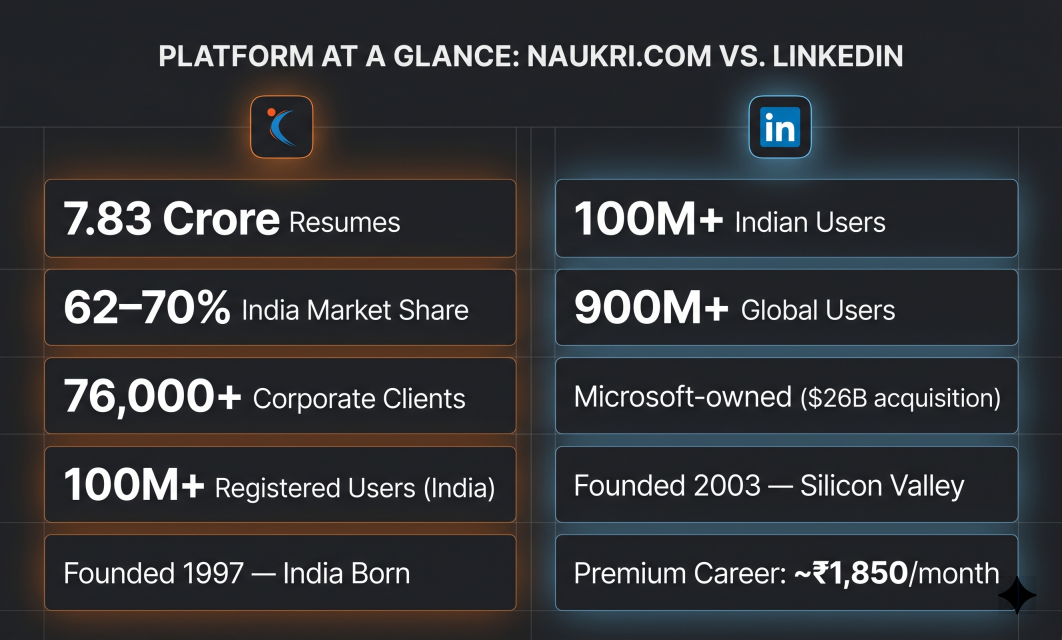
Sanjeev Bikhchandani launched Naukri.com from a garage in Noida when the internet in India was barely a rumour. He charged companies ₹5,000 a month to list jobs. People thought he was crazy.
They were wrong.
By 2006, Info Edge took Naukri public. By 2025, it was sitting on a database of 7.83 crore resumes, holding 62–70% of India's online recruitment traffic, and running a revenue engine of ₹5.5 billion in just one quarter.
LinkedIn, meanwhile, was born in 2003 in California — a place where a warm introduction could land you a job at a startup that would become a billion-dollar company. It was never meant to be a job board. It was built as a networking layer for professionals. Microsoft bought it in 2016 for $26 billion.
Today, over 100 million Indians are on LinkedIn. And yet, the two platforms couldn't be more different in how they actually work — who sees you, who contacts you, and whether that contact leads anywhere meaningful.
So in 2026, which one actually gets Indian candidates hired?
The honest answer is going to annoy some people.
The Uncomfortable Split: What Each Platform Is Actually Built For
Here's what nobody tells freshers when they're setting up both accounts in the same sitting:
Naukri is a database. LinkedIn is a network.
Those are fundamentally different things — and treating them the same way is the biggest mistake Indian job seekers make.
When a recruiter opens Naukri, they type keywords into a search bar. Your profile either surfaces or it doesn't. There's no relationship, no context, no personality. Just keyword match, resume score, and last active date. That's it. The whole machine runs on volume — and Naukri has built an extraordinary volume machine.
When a recruiter opens LinkedIn, they might search too — but they also look at who their connections know, who's commenting on industry posts, who just shared something sharp about their field. The discovery mechanism is fundamentally social.
This distinction matters more in 2026 than it ever has before.
Naukri in 2026: The Workhorse That Never Stopped Running
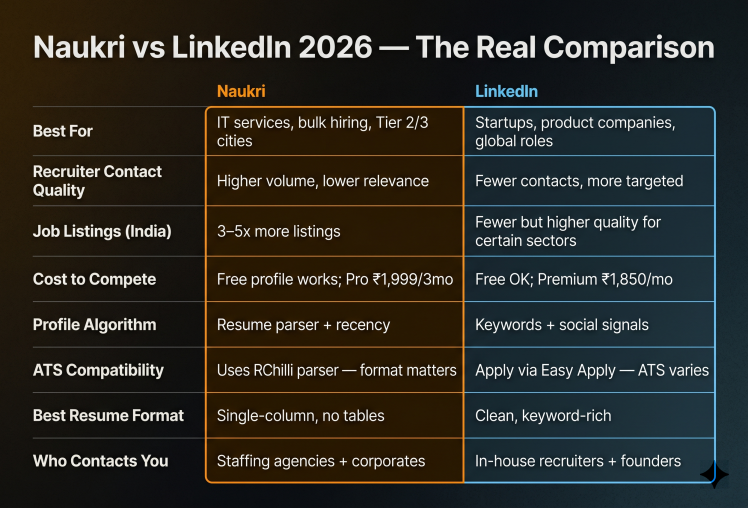
Let's be direct about this. If you're in IT services — TCS, Infosys, Wipro, HCL, Cognizant territory — Naukri is non-negotiable. Those companies source heavily from Naukri's database. Bulk hiring, lateral movement, campus-to-corporate pipelines — it all runs through Naukri.
The numbers are blunt:
- Naukri has 3–5x more job listings than LinkedIn for India-specific roles
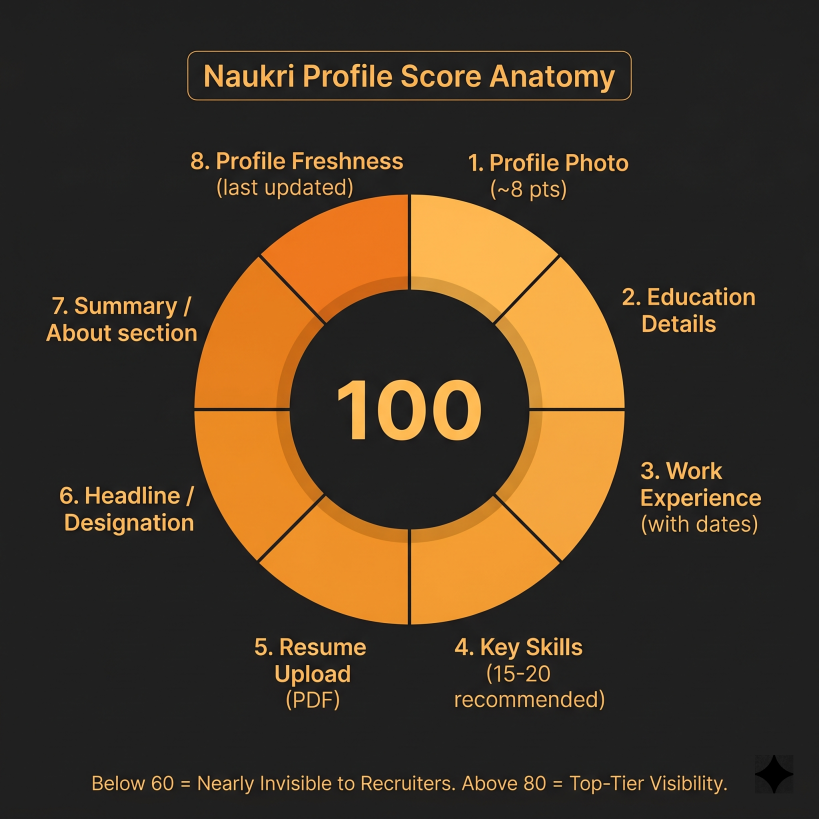
- A profile with 100% completeness gets 4x more recruiter views than a 50% complete one
- The Resume Score system (0–100) directly controls your search ranking — drop below 60 and you're largely invisible
- Naukri's parser uses RChilli technology to strip your resume and index it — tables, skill bars, and multi-column formats all confuse it
The last point is where most people quietly sabotage themselves. They spend hours designing a beautiful resume, upload it to Naukri — and the parser breaks it. Skills section becomes invisible. Designation gets misread. The recruiter searches for "React Developer, 3 years" and the candidate who formatted their resume correctly shows up instead.
The Naukri Premium Question
Naukri launched an AI-powered resume maker in late 2025 — available on Naukri 360 (₹399/3 months) and Naukri Pro (₹1,999/3 months). The Pro tier also unlocks profile enhancement and priority visibility.
Is it worth it? For active job seekers in mid-level roles — yes, particularly the Profile Booster feature (₹699–₹1,499/month) which keeps you appearing in recent searches. For freshers, the free profile optimised correctly is often enough.
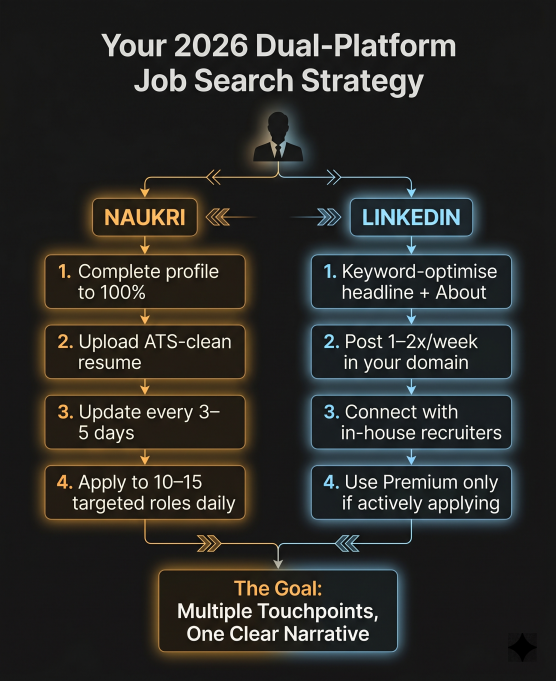
The real hack on Naukri that almost nobody talks about: updating your profile every 3–5 days. Naukri's algorithm shows recruiters the "Last Updated" date. A profile last touched 30 days ago signals passivity. Updating even one line of your summary counts as fresh activity. This one behaviour change costs nothing and consistently lifts search rankings.
LinkedIn in 2026: Powerful, Expensive, and Frequently Misunderstood
LinkedIn is where the product companies live. Startups. D2C brands. Global tech firms with India offices. If you're targeting a FAANG-adjacent role, a funded startup, or any company where culture-fit matters as much as skill-fit — LinkedIn is where that conversation begins.
The platform's search algorithm in 2026 has gotten sharper. Keyword optimisation on your profile headline and About section now accounts for a significant share of how you're discovered. A profile with a vague headline like "Looking for opportunities" is LinkedIn's equivalent of wearing camouflage at a networking event.
The Premium Dilemma
LinkedIn Premium Career in India runs at approximately ₹1,850/month — meaningfully more expensive than Naukri Pro. What do you get?
- Featured Applicant status — your application surfaces near the top of recruiter screens
- InMail credits (5/month) — direct messages to anyone, no connection required
- Applicant insights — see how you compare to other candidates on a posting
- Profile views — full visibility into who's looked at your profile in the last 90 days
- LinkedIn Learning access
The Featured Applicant badge alone has genuine value if you're applying to competitive roles. The applicant insights help you understand whether you're over-qualified, under-qualified, or in the sweet spot — before you invest time in a cover letter.
But here's what LinkedIn won't tell you: Premium doesn't fix a weak profile. Most people who say LinkedIn Premium "didn't work" for them had a profile that wouldn't have worked for free either.
The Controversy Nobody Wants to Address
Here's where we need to be honest about something the career advice industry tends to sidestep.
Naukri is flooded with spam.
Ask any experienced professional with an active Naukri profile and they'll tell you the same thing — the recruiter contact volume is high, but the relevance is often poor. Staffing agencies contacting senior engineers for entry-level contracts. Bulk SMS-style outreach for roles three levels below the candidate's experience. A React Developer with seven years of experience getting calls for "computer operator" roles.
This isn't a bug. It's a structural outcome of a volume-based marketplace. Naukri's business model rewards recruiters for searching and contacting, not for quality-matching. Until that incentive changes, the spam problem stays.
LinkedIn has a different problem — performative professionalism. The platform has gradually become a place where people post thought leadership content of varying quality, congratulate each other for getting jobs, and perform career success for an audience. The signal-to-noise ratio on the feed is genuinely low.
The InMail system, while useful, has been increasingly gamed. Generic copy-paste InMails from offshore recruitment firms are now just as common as genuine outreach from quality companies.
Neither platform is perfect. Both have structural issues baked into their business models.
What 2026 Has Changed: The AI Shift
Both platforms doubled down on AI in the last 12 months.
Naukri's AI resume maker (launched late 2025) can generate and refine profile content. It's useful but not transformative — the content tends to be keyword-correct but personality-flat. Naukri's FastForward feature now ranks resumes across three AI-evaluated factors, and companies like TCS and HDFC Bank use it to pre-filter candidates before human review even begins.
LinkedIn's AI tools analyse your profile against recruiter search patterns and suggest edits for discoverability. These are built directly into the platform — no copy-pasting required. The convenience is real, even if the output still benefits from human editing.
The honest take: AI on both platforms is a floor-raiser, not a ceiling-breaker. It gets weak profiles to average. It doesn't get average profiles to exceptional. That's still a human job — and it's where tools like Nord Resume come in.
The Verdict: Use Both, But Not the Same Way
The smartest job seekers in India right now aren't choosing between Naukri and LinkedIn.
They're using Naukri as a discovery engine — show up in recruiter searches, apply to volume, stay fresh and visible.
They're using LinkedIn as a credibility layer — a place where a recruiter can find you, read something you've said, understand how you think, and feel confident before they even send a message.
These aren't competing strategies. They reinforce each other.
A recruiter finds you on Naukri. Before calling, they Google you. They find your LinkedIn. Your LinkedIn shows three sharp posts about your domain, a crisp headline, and a profile photo that doesn't look like a passport scan. They call you with a different kind of confidence than the recruiter who's cold-dialling from a database.
That's the play.
Before Any of This Works: Your Resume Has to Be Right
Here's the part most comparison blogs skip entirely.
Both platforms are distribution channels. What you're distributing is a resume. And if that resume is formatted wrong, keyword-poor, or structurally broken — no algorithm, no Premium subscription, no profile booster is going to fix it.
Naukri's RChilli parser breaks on columns, tables, and graphic elements. LinkedIn's Easy Apply sends whatever PDF you've uploaded straight to the company's ATS. Most ATS systems in Indian companies still choke on anything that isn't clean, single-column text.
A well-structured resume is the foundation. Everything else is amplification.
One Last Thing
Both platforms are tools. Tools don't get you jobs — people do.
The recruiter on the other side of that Naukri call is a person. The hiring manager who saw your LinkedIn post is a person. Every connection you make, every keyword you pick, every resume you send is an attempt to communicate one thing clearly:
Here's who I am. Here's what I can do. Here's why you should talk to me.
Get that communication right. The platforms are just the delivery mechanism.
Nord Resume builds clean, ATS-ready resumes that work on Naukri, LinkedIn, and every hiring system in between. Try it free →
job search naukri linkedin career advice resume tips india jobs 2026 job portal comparison